
Note to reader: real estate investors and those who are able to work remotely or are retired have been transitioning out of the urban areas and into more rural settings. The trend seems to be continuing although the covid crisis is now at least 5 years ago. My anecdotal investment experiences conform with Redfin’s findings. I have also observed that rent rates have been climbing faster in the rural areas in which I have been investing.
Just because there is plenty of land in the rural areas of the United States does not mean that building homes are much cheaper. In order to build a rural home, there must be readily available utilities, such as easy access to the electricity grid, as well as built out public sewers and water supply. Also, roads must be constructed and these types of build-outs can add astronomical sums to the prices of rural new home construction.
Very often, homes built in rural settings lack this available infrastructure and thus, wells and septic systems must be built. If readily available electricity is not present, electricity lines must be made available to the new structure. It’s estimated that a 10-pole line can easily cost more than $100,000. Building a single-family home in a rural setting can actually be more expensive than elsewhere.
- Rural homebuyers need to earn $75,000 to afford the typical home, up from $36,000 before the pandemic. Suburban and urban areas have also seen affordability erode—but not as severely.
- The median home sale price in rural areas is up 61% from before the pandemic, compared with a 49% increase in suburban areas and a 46% gain in urban areas.
- The median household income in rural areas has climbed 33%, less than the 37% increase in suburban areas and the 39% uptick in urban areas.
Rural America has been hit by a one-two punch of rising home prices and lagging incomes, and as a result has seen housing affordability erode faster than big cities and suburbs.
Homebuyers need to earn an annual income of $74,508 to afford the median-priced home in rural U.S. counties. That’s up 105.8% from before the pandemic, when rural buyers needed to earn $36,206.
By comparison, the income needed to afford a home in suburban counties has risen 90.9% (to $102,120 from $53,482), and the income needed to afford a home in urban counties has climbed 87.5% (to $118,300 from $63,103).
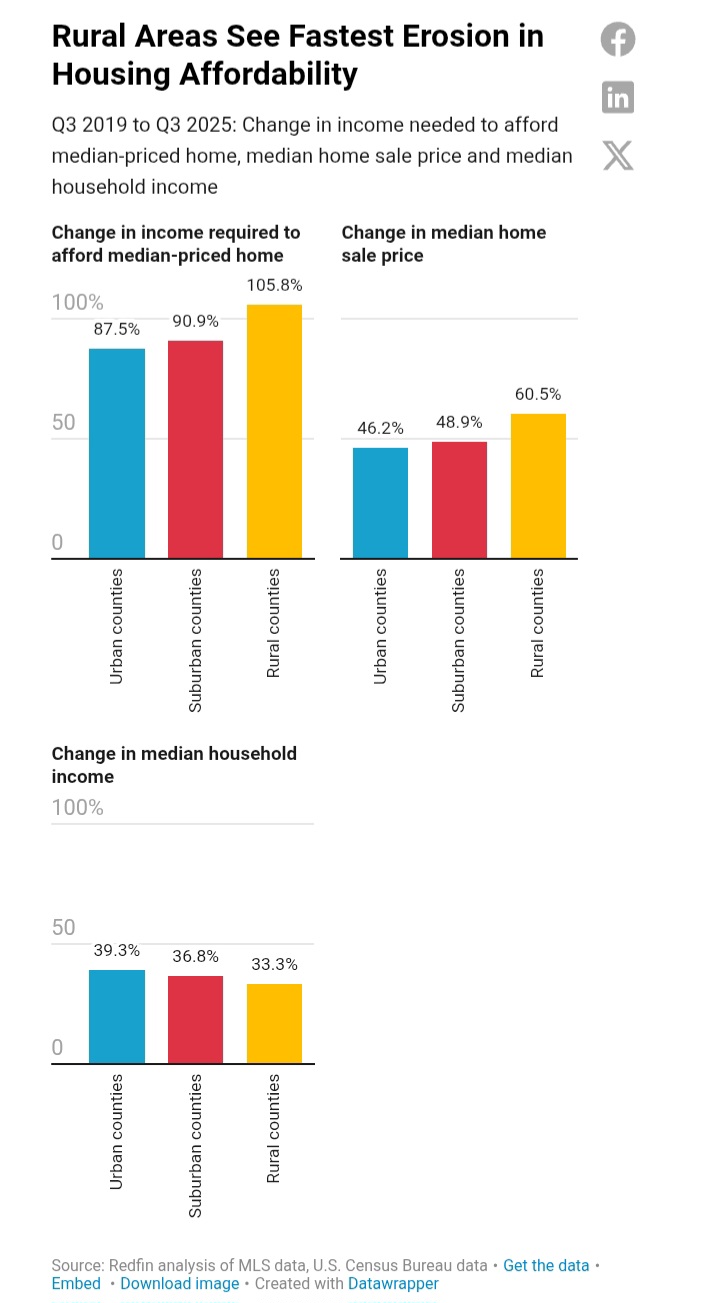
This is based on a Redfin analysis that compares the third quarter of 2025 with the third quarter of 2019. We consider a home affordable if a buyer taking out a mortgage spends no more than 30% of their income on their monthly housing payment. This analysis uses MLS median home sale price data, prevailing mortgage rates and property-tax payments, and U.S. Census Bureau data on incomes.
Homebuyers in rural areas have faced relatively large jumps in home prices, which is one reason affordability has eroded. The median sale price in rural counties is $280,900, up 60.5% from $175,000 before the pandemic. By comparison, suburban counties have seen a 48.9% increase (to $385,000 from $258,500) and urban counties have experienced a 46.2% gain (to $446,000 from $305,000).
Income growth also hasn’t kept up. The median household income in rural counties is $69,307, up 33.3% from $52,002 before the pandemic. By comparison, suburban counties have seen a 36.8% gain (to $88,627 from $64,782) and urban counties have seen a 39.3% gain (to $89,784 from $64,468).
Big cities fell out of favor during the pandemic, when scores of Americans moved to rural and suburban areas in search of space, privacy and access to nature. Some were seeking a lower cost of living, while others were buying up pricey vacation homes in places like Lake Tahoe. Record-low mortgage rates and remote work were the forces that empowered millions to relocate. The pandemic homebuying frenzy that swept through rural and suburban areas sent home prices soaring, leaving many communities grappling with an affordability crisis that persists today. Rural areas often only have a handful of homes for sale, meaning homebuyers frequently compete with one another—another factor that drives up prices.
New Hampshire Has Seen the Biggest Increase in Income Needed to Afford a Rural Home
Homebuyers need to earn an annual income of $119,361 to afford the median-priced home in rural New Hampshire. That’s up 141.4% from before the pandemic—a bigger increase than rural areas in any other state Redfin analyzed. It’s followed by neighboring Vermont and Maine, which saw respective increases of 139.2% and 137.3%.
These states top the list because they’ve seen the largest increases in home prices. The median rural home sale price in New Hampshire is up 88.3% from before the pandemic—a bigger increase than any other state Redfin analyzed. Next came Vermont and Maine, with respective increases of 86.6% and 85.1%.
Redfin research article continues. Please refer to Redfin’s analysis on its website for further information.
Interesting tid bit: the naturalization acts before the civil war, ” limited those who were eligible to be nationals as free, white persons”. They also referenced, free white people of good morale standing. That all changed in 1866 under Reconstruction.
Or as some of us say, “Deconstruction”. ✡️✡️✡️
Charge It!
Every religion proclaims lord or god or God. The Israelites proclaimed to YHVH or YHWH. Up until 150 AD until the scripts were manipulated. Constantine murdered those scholars who proclaimed that name and he burned their scripts. The Edomite Cain Jew religion of the Roman Catholic Church started it all and the Protestant branches all proclaim the same thing.
We Christians proclaim a name that is alien to our Heavenly Father, YHVH or Yahweh, and that isn’t a Midianite god.
By the way, Midian was one of Abraham’s sons. Moses’ wife was a Shemite woman descended from Midian. Jethro was a direct descendant of Abraham through Midian. They also lived in Midian. Zipporah wasn’t a schvartze.
There goes the schvartze religious communism thing. The Catholic Church is a bed full of lies. The Protestant mongrel children all follow it.
Everything the church discusses today is a complete fraud. It tries to fit its lies into its religious communism for the end time whore.
Hey, you lost Israelites, the law has never been put away. Perhaps it’s time to start following the law and crying out to Father Yahweh YHVH.
Ever wonder why the world is a garbage dump? Perhaps it’s because the lost sheep follow the judeo-christian line.
I know old habits die hard… Say his name.
That is a fact!!! A few weeks ago I commented on the proper name. Just put the vowel letter a in between the consonants and you have the meaning of everlasting life, breathe, love, self existence.
Here is a clue, John 20:22 And when He had said this, He breathed on them, and said to them, “Receive the Holy Spirit. YHVH is Spirit.
I’ve seen debates on different forums with those spelling variations. There wasn’t a letter J in the Hebrew language? So an I or a Y took its place. Yet are those the same letters or symbols that are in the English alphabet, a Hebrew letter Y isn’t the same as an English or other language letter Y? The goal is to find out the specific name and also to correctly pronounce it. Then there is the spirtual aspect, where if one calls out, and just mentions “God” or “Jesus” then that will be okay.
Yes, the letter j didn’t really show up till the late 16th century. Some Swedes spell their names with a j but the pronouncement is like the y sound. The goal as you said is worth the effort.
We might not know how to pronounce it, but the Kabbalists do and use it in to invoke and channel in their magic ceremonies
As per GROK:
is the tetragrammaton used to conjure spiritual forces
Finished
Yes, in Kabbalistic and esoteric traditions, the Tetragrammaton (YHVH) is used to invoke and channel divine spiritual forces
That sounds just like GROK.
For the most part, I don’t use AI algorithms when asking about financial and economic matters. This is because very often the AI results are actually the opposite of the correct answer.
For instance, higher grain prices for farmlands would raise net operating income, all other things being equal, and would raise the land’s capitalization rate.
However Google’s AI plainly states that higher grain prices lowers the capitalization rate. This result was found basically universally across my searches. This was just done a few days ago.
The same thing goes with the AIs description of the repo window versus reverse repos. The answers are almost universally the opposite of the correct response when it comes to the actions of the Federal Reserve. Essentially, I can’t use AI at all, at least not in its present form.
When it comes to using AI, there’s going to be a lot of retardedness that will be regarded as the correct response, regardless of validity.
Moreover, AI results are definitely being manufactured to conform to predetermined outcomes. In other words, AI is woke and Antichrist by its nature.
When it comes to using AI regarding matters of the written word, I’ll take the contra.
Look at the people behind the A.I. movement. Lets just say they are in the same club. I wouldn’t seek counsel from a demonic entity! Test the spirits!
That’s absolutely correct. As humanity and especially Adamic man wrap up this age, there will be no truth in the land.
Totally. I stopped using it except as an occasional search engine. Googles is the worst. It’s basically useless in any other capacity for us plebs.
Receipts
occult-world.com/tetragrammaton/
hermetic-academy.com/tetragrammaton-magick/
The stories about YHVH and its name go back the 25 years I’ve been studying it. Lots of distractions and lots of disinfo.
For every one person such as myself who says such a thing, there are 10 others who say the opposite. Take heart, you are amongst the crowd.
I like the person who said that Yahweh was a Midianite dirt devil god. However, since Midian was a purely Shemite son of Abraham, through his second wife, Keturah, most of Midian knew all about YHVH, and that was their God. Yes, when Moses went to Midian, the Midianites god was YHVH Yahweh. That’s why Moses went there. He met his Yahweh worshiping wife.
Do you think Moses is that stupid to marry a schvartze pagan?
Say my name.
During the Pope Benedict XVI administration, I think in 2008, he ordered that all remaining references to YHVH be removed from any writings, lest the Catholic Church upset the Jewish rabbis and its Jewish brethren. The Talmud and the teachings of the rabbis forbid people from saying the true name. That’s because the Catholic Church and the rabbis inadvertently pray to the same god, and by extension, the Protestant churches as well.
The Jews do not want any of us saying the real name. This goes back almost at least 1900 years.
Judaism deliberately obscures all Truth including the True Creator. Revelation 4:11 You are worthy, O YHVH, To receive glory and honor and power; For You created all things, And by Your will they exist and were created.”
That creation includes the angelic host and satan!
More specifically, the one who became satan!
The Soylent Green economy is alive and well.
Black Friday Sales Rise, Signaling US Consumers’ Resilience
(Bloomberg) — Sales on Black Friday rose from a year earlier, according to a key data provider — a sign that US consumers are continuing to spend despite persistent economic concerns.
Retail sales, excluding autos, increased 4.1% on the day after Thanksgiving, according to data from Mastercard SpendingPulse. That surpasses last year’s 3.4% growth. The figures, which are not adjusted for inflation, draw from both online and in-person purchases to give a broad view of economic activity.
The data shows US shoppers’ resilience amid higher costs and job-market concerns. To appeal to price-sensitive consumers, retailers are offering discounts on a wide range of goods — although the promotions may not be quite as deep as in past years. Companies are also highlighting newer, exclusive items for the season, ranging from $10 couch throws to $5 Barbie dolls.
The holiday season is a key barometer for consumer demand, with executives, economists and investors closely watching households’ spending habits. While shoppers tend to splurge at the end of the year on gifts, trends have started to shift and higher costs across the economy have fueled concern that consumers will buy fewer items.
In-store sales rose 1.7%, above last year’s pace. Online sales rose 10.4%, lower than last year’s gain.
“It clearly shows that the consumer has the ability to spend,” Michelle Meyer, chief economist at the Mastercard Economics Institute, said in an interview.
Despite macroeconomic swings, shoppers appear to have purchasing power and were spending at a consistent level heading into Black Friday. Still, the outlook for the rest of the shopping period remains in flux — including how much of the sales growth is driven by inflation versus units and to what extent people open up their wallets through the end of the year, she said.
On Black Friday, retailers catering to teens and 20-somethings were standouts that drew heavy traffic. Stores offering large discounts also attracted big crowds. Walmart Inc. said Vizio TVs, Oura rings and seasonal toys were popular items and shoppers were looking to maximize deals. Holiday decor and tools sold well at Home Depot Inc.
Still, many shoppers said deals seemed more muted compared with last year, at least initially. Retailers are offering gifts to appeal to cautious consumers. Target Corp. said, on average, 150 shoppers waited at opening time for free giveaways.
While preliminary data on retail performance will be released in the coming weeks, definitive information on companies’ performance won’t be available until early 2026.