
QE is dead, long live QE!
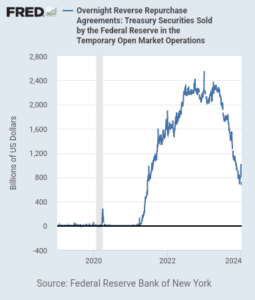
The RRP facility continues to show big drops in excess bank reserves at the FED, which is now down to $694 billion. Who will be around to buy up all that future UST stockpile? The Fed will have to stop its unwind, so the federal government can finance trillions in foolish multicolored largesse and wasteful tax credits on EVs and solar panels.
Does money grow on trees?
Don’t be fooled by the rantings in the alt-media. Money does indeed grow on trees… that is for the asset owners. The generated money all ends up in the balance sheets of the asset owners as the unilateral transfers from the Feds are spent by the multicolored rabble and the Federal agencies (DoD, GSA, NSA, USDA, FHA, etc.) and end up in the hands of those who can capture all that spending and money.
Wealth and power consolidation has never been more straightforward. Yet the alt-media and those who are unable to articulate the process, like Joel Skousen, quote Zerohedge and the Epoch Times and declare a collapse must follow as a result of all the craziness and greed.
What fools! Money does indeed grow on trees.
Here is a link to USTs Debt to the Penny site. Buy the assets to capture the money growing on the trees. The $34 trillion mark has been crossed…
$34,006,270,930,685.56
https://fiscaldata.treasury.gov/datasets/debt-to-the-penny/debt-to-the-penny
All of this fiscal deficit spending is spent and ends up on to the balance sheets of those who own the assets that can capture this spending. Socialism is the preferred method by the establishment as a means to consolidate their wealth and power over the unwashed masses. Socialism creates a populace of needy, dependent, and docile debt slaves.
As the banking liquidity mechanisms drain, the Fed will have to reassert itself
Below, I present you with a timely and unedited Bloomberg article concerning QT and how the Fed will need to cease its balance sheet unwind. After the RRP facility is drained, bank reserves will be considered to be too low, given the high public debt needs. In other words, who will be around to absorb all the additional debt if the Fed IOER and RRP facilities are drained and the Fed continues to unwind? There will not be enough savings available unless MM funds rates rise to attract buyers. The Fed must cease its unwinding within a few months by Springtime…
Forget Rates, Now Worry About the Fed Unwinding Its Balance Sheet
(Bloomberg) — The memory of a corner of the funding markets blowing up more than four years ago is still seared into the brains of many market participants. That episode will also be back of mind for the Federal Reserve as it attempts to halt its balance sheet runoff again.
This past week, the minutes from the latest Federal Open Market Committee meeting revealed that the Fed is already thinking about its balance sheet. But the last time the Fed attempted to slowly halt the process of unwinding its balance sheet — a process known as quantitative tightening, or QT, its efforts lasted only months before ructions in 2019 in the funding markets prompted a re-think.
During that episode, there was already evidence that bank reserves — a bellwether for how it conducts policy — were scarce. That is, financial institutions had just enough cash to satisfy regulatory and balance sheet needs. As a result, this exacerbated typical pressures when the combination of increased government borrowing and a corporate tax payment exacerbated a shortage of reserves. Overnight repo rates — widely relied upon by Wall Street to fund day-to-day operations — jumped five-fold to as high as 10% and order was only restored after the Fed restarted repo operations to stabilize the market.
While funding markets are nowhere near those extreme levels today, a number of recent events have caused some market participants to believe it’s time for the Fed to start thinking about ending QT. For starters, balances at the overnight reverse repurchase agreement (RRP) facility, which represent excess liquidity in the financial system, have fallen by nearly $1.5 trillion since June. Moreover, bouts of volatility at the end of November and December drove the Secured Overnight Financing Rate to new all-time highs.
As a result, in the minutes of the December Federal Open Market Committee Meeting released earlier this week, policymakers said it would be appropriate to begin discussing the factors that would guide the central bank’s decision to slow the pace of QT well before a decision has been reached.
“This is a very prudent step,” said Mark Cabana, head of US interest rate strategy at Bank of America Corp. “We very much worry that the lowest comfortable level of reserves is substantially higher than what the Fed had previously suggested it might be. It’s constructive that they’re starting these discussions now as opposed to waiting and needing to start them as money-market rates rise much more rapidly.”
The cautiousness exhibited in the minutes is an about-face from Chair Jerome Powell’s comments at the December post-meeting press conference. At that time, Powell had signaled he was comfortable with the current level of reserves and said the central bank would slow or halt balance-sheet reductions as needed to make sure they remain “somewhat above” a level the Fed considered “ample.”
For over 18 months, the Fed has been letting as much as $60 billion in Treasuries and as much as $35 billion in agency debt holdings mature every month.
By contrast, the last time the central bank attempted to shrink the size of its balance sheet in 2018, it was only letting as much as $30 billion in Treasuries and as much as $20 billion in agency debt run off — nearly half the size of the current plan. In May of 2019, the Fed slashed the reinvestment cap for Treasuries to $15 billion before eliminating the limit entirely in August, while continuing to let its mortgage-backed securities holdings roll down. That first era of quantitative tightening lasted less than a year.
The problem now is that it’s unclear how many reserves would constitute an “ample” level. Recent market angst and the central bank’s latest survey suggests that a reserve balances at $3.46 trillion may not be as ample as policymakers think, especially given many institutions suggest they prefer to hold a buffer of reserves to ensure they have enough liquidity.
At the same time, Wall Street strategists are hopeful a plan is in place before the Fed’s RRP facility is nearly empty. Bank of America’s Cabana is skeptical the Fed will be able to continue QT for much more than a quarter after the facility is drained, with the risk that policymakers will have to slow or stop the Fed’s balance sheet reduction in the second quarter. That’s in line with Barclays Plc’s outlook, with the Fed ending QT in June or July. Deutsche Bank AG analysts expect the slowing of the balance sheet unwind to coincide with central bank rate cuts beginning in June.
“Rather than risking a spike in funding rates as happened in 2019, we expect the Fed to err on the side of caution,” Barclays strategist Joseph Abate wrote in a note to clients. “This argues for stopping QT sooner with bank reserves perhaps still above $3trn and some lingering balances (of a few hundred billion dollars) in the RRP.”
Link to original Bloomberg article (and not behind paywall):
https://finance.yahoo.com/news/forget-rates-now-worry-fed-181213522.html
It is interesting how they come out with some economic figures that swing the markets in an extreme direction then the next day they come out with economic figures that go the opposite direction that reverse most of the prior market movement.
Anybody who believes these markets are free capitalist markets is living in another world. The whole economy including the stock market is controlled by a powerful invisible hand with an agenda.
Inflation will never go away as long as most people are self entitled and demand free handouts.
A lot of people getting sick lately for prolonged periods of time. What is unusual compared to the past is that these sicknesses last much longer. These are signs of weakened immune systems.This could affect employment numbers and labor participation rates pretty soon. Check out this blog:
https://www.reddit.com/r/conspiracy/comments/191wt3f/not_sure_what_sickness_has_been_going_around/?rdt=42357
Nobody in the mainstream media is talking about the elephant in the room causing the weakened immune systems resulting in the prolonged sicknesses (the Covid Clot shots).
Amen. Those who are vaccinated and sick will be poor and broke due to all the medical bills. They will have a stark choice of take the mark to get medical care or forego medical care without the mark. The vaccinated will most likely take the mark.
I feel it more in 2024 that we are starting the tribulation as foretold in the Bible.
We Christians must isolate ourselves from humanity as the masses become more like asses.
Just watch today’s tv shows and listen to today’s music to see that the average person is getting stupider by the second. I have been distancing myself from a lot of people recently as they have more toxic group think.
The Bible does predict disasters and war, however, the economic system still will function very well for the top 1% . It is obvious when it is stated that the wine and oil( luxury items) will be preserved and in abundance while things that the masses use will be in very short supply.
There will be an excellent economy for the top 1% while the bottom 90% will experience economic depression.
Question: If inflation is going to stay stubbornly high, as some economists suggest, how can the Fed reduce rates more than the anticipated 75 basis points, starting in June? Further, the US is under pressure to keep rates higher to make Treasury notes appealing to foreign buyers , like Japan. The Chinese are still dumping US Treasuries and rates have to be appealing for other countries to buy the Treasury notes, as suggested by some analysts.
Finally, after the US election in November, some are predicting, like Martin Armstrong, chaos in the US and interest rates rising into 2025. Hmmmm?…..
Thank you.
Excellent! Thanks for putting it all in perspective. I enjoy the blog very much. Keep up the excellent work.
Gary
Worth a read IMO. Written last year. I started to read into the Uniform Commercial Code and what he says crosschecks when one has drilled down far enough. The only thing missing from this would be how it would be enforced. Would US judges and thus the police acquiesce to having people’s “securities” stolen by preferred creditors if a collapse comes to pass? https://thegreattaking.com/
I also went looking for who the actual owners/shareholder of the US Federal Reserve are but found little other than chartered US banks. Can anyone point to a source listing who the actual owners are?
The guy who checks our mouse traps every month was telling me about this book. Everyone is sending me links about it and telling me that I should read it. I will pass, thanks.
Check Eustace Mullins for Fed. Res. ownership, or if you must G. Edward Griffin.
It looks like there will be no drama surrounding the debt ceiling/funding issue. It’s early too.
I suppose the FED ending QT is timely, it seems there does not even need to be a new crisis to move things along, they can just glide back into some form of QE. The public doesn’t care.
Vaccines just don’t work:
https://www.zerohedge.com/political/did-vaccine-eradicate-smallpox
Why take something that carries side effects and doesn’t work as promised?
However, many people still faithfully take the flu and Covid shots each year.
I think at some point soon the Fed will have to turn on the spigots again to fund the government’s expenditures. Hold on to stocks and RE which ever way the prices go. History has proven that they only go up when there is rising government expenditures. Government expenditures will never go down due to political pressure from the sheeple. Every politician that put a damper on expenditures got voted out.
Elon Musk lit up a marijuana bong while as a guest on a video talk show. He obviously has drug addiction issues.
Moon shot tomorrow if all goes well. This time they are trying a new unmanned lunar lander (not like the jiffy-pop Apollo lander) and will apparently be depositing the remains of Gene Roddenberry in the “Sea of Stickiness”. Also being deposited is one BTC with the address on a physical coin – it should land 23Feb. Something like 40 days.
The Apollo mission was reportedly 8 days total – there, back and a little time to land, mess around, and take off from the moon. Why so slow this time? Maybe this time it’s an eco-friendly rocket booster, kind of like a Prius.
The modern day Kubrick, Daniel Langlois, was killed in Dominica late last year.
https://globalnews.ca/news/10169825/daniel-langlois-murder-timeline-dominique-marchand/
He is the pioneer of CGI.
Is space real? Is the moon real? Could Nasa’s pictures be just fake? Maybe the medieval Catholics are correct that all the planets and sun revolve around the earth just like they are correct about creationism as described in Genesis. Like Darwinism, which is a load of crap, this whole moon landing thing and outer space thing is just recent and may be a load of baloney as well. I am just throwing this out there for discussion.
Take all this to the Lord in prayer.
Look at the description of the Earth in the Bible. Their is your answer!