
Note to reader; there are too many coincidences since early 2020 for any of the current economic circumstances to be random. Each fiscal and monetary action in the wake of the emergence of covid in early 2020 built off of one another and was well calculated. We know, because we articulated the ramifications of such policies in real time.
The authorities continue to get away with it, because the scared mixed people can no longer mount any resistance and are now too busy fighting amongst themselves to spot the synagogue of Satan banking cartel perpetrating it all.
Via positive economic analysis, we have been able to determine the repercussions to the asset markets. Although the government’s stated normative policy was ostensibly designed to help guide the nation and citizens through the covid crisis, we knew there were much more effective strategies to achieve the government’s stated goals.
I ask, why have small businesses been left twisting in the wind? Despite rents skyrocketing, why have small landlords been pummeled? Why have wage earners been left behind? Why are the income and wealth disparities continuing to widen? Why did the costs of home ownership escalate much higher than general price inflation?
This blog has provided the answers to these questions. The covid fiscal and monetary policies were just part of a larger set of objectives that are designed to disenfranchise small entrepreneurialism and individual financial independence. Understanding the conspiracy beforehand, we predicted the results more accurately than elsewhere.
None of this was left to chance and the covid crisis has been exploited by the enemy to reformulate society in every facet.
I have a more sobering conclusion for the reader. If I extrapolate according to trend, by the end of the decade, most of the nation will be a sickly population of servants who will rent everything from the large corporations. Although there will be a lot of static and diversion along the way, the outcome has already been predetermined.
For those with the insight and guts to act, the covid crisis has actually helped enhance their financial standings. For the readers of this blog, we have been able to adjust our behaviors and choices based on what’s truly in front of us and not with how it’s presented by the media.
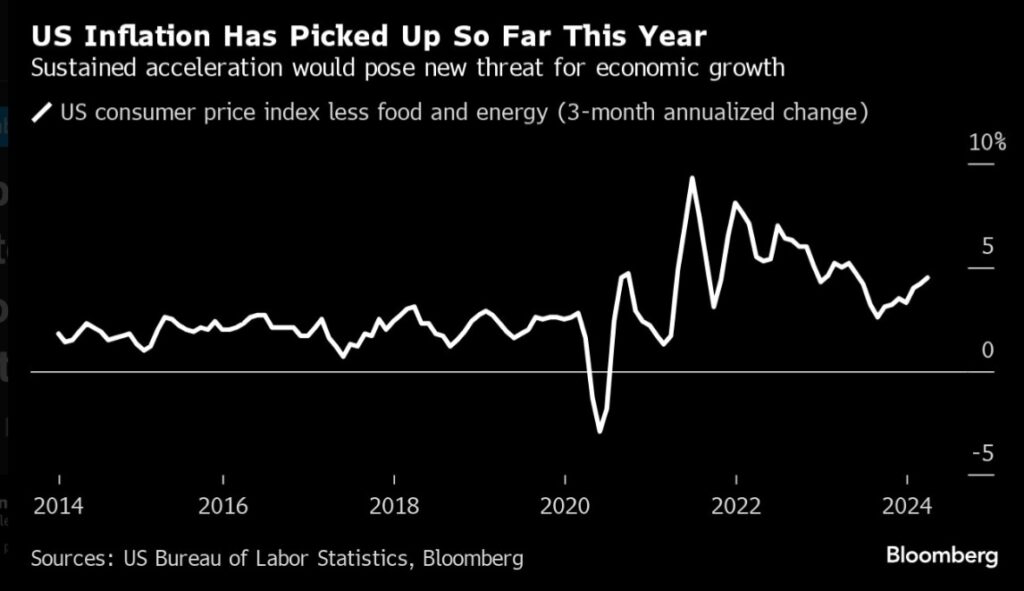
Stubborn Inflation Poses Risk to Recently Upgraded US Forecasts for Economic Growth
(Bloomberg) — So far, 2024 isn’t going quite how it was supposed to for the US economy: Inflation has been higher than expected and household spending seems to have lost some momentum.
Those trends represent a new risk for economic growth forecasts that were upgraded around the turn of the year, largely on the view that rapid disinflation would help bring about rising real incomes and lower borrowing costs.
Two key reports due Wednesday, on consumer prices and retail sales, will give an indication of how real the threat is to the outlook. Payroll and wage growth slowed in April, and without a corresponding cooldown in price increases, families’ budgets will come under further strain.
“If inflation remains sticky, that actually introduces significant downside risk to the growth outlook because labor markets aren’t in the same place,” said Neil Dutta, head of US economics at Renaissance Macro. “You’re going to have to start worrying about what that means for real incomes.”
Consumer prices excluding food and energy rose at a 4.5% annualized pace in the first three months of 2024, a step up from the 3.3% annualized increase in the fourth quarter. Retail sales, meanwhile, were up just 0.4% in the first quarter after adjusting for inflation, according to a Bloomberg Economics estimate, compared with the 2.9% increase that closed out 2023.
In April, economists expect monthly inflation to step back down to a pace more in line with the end of 2023, while they see growth in retail sales, which aren’t adjusted for inflation, slowing.
Forecasters are typically reticent to overhaul their outlooks after just a handful of surprises, but there are signs that doubts are starting to creep in after three successive months of higher-than-expected inflation figures. Consumers may have taken their cue from the reports, with year-ahead inflation expectations moving up in recent University of Michigan surveys.
Federal Reserve Chair Jerome Powell, speaking after the US central bank’s latest policy meeting on May 1, said officials “don’t like to react to one or two months’ data, but this is a full quarter and I think it’s appropriate to take signal now.”
At that meeting, Fed officials kept interest rates at the highest level in more than two decades, where they’ve been since July.
Economists at S&P Global Market Intelligence said in a May 9 report that they were making slight downward adjustments to their estimates for growth in 2025 and 2026, thanks to a later start for Fed rate cuts.
That’s why so much is riding on the data due this week, especially amid signs the labor market is cooling. A monthly employment report published on May 3 showed average hourly earnings rose just 2.8% annualized in the three months through April, the least since the first quarter of 2021. And a widely-followed leading indicator of wages — the quits rate — points to more deceleration ahead.
Meanwhile, excess savings accumulated during the pandemic — another major driver of consumer spending in recent years — may finally have been exhausted as of March, according to a recent San Francisco Fed estimate.
There are good reasons to think the recent uptick in inflation is set to reverse in the coming months. One of the main culprits behind the elevated figures in the consumer-price index has been a slower-than-expected pace of moderation in rental inflation. That indicator tends to lag, in part because changes are reflected in the official data only when people move or renew their leases, and should soon start following measures of current rents lower.
The other major factor was a surge in motor-vehicle insurance costs, which economists also expect to eventually slow. Forecasters don’t see rising housing and insurance costs as reflecting an increase in underlying demand — meaning they’re not threatening to further heat up inflation.
“Car insurance surprised us to the upside last print, but we don’t see evidence of structural changes pointing to a sustained acceleration,” a team of Morgan Stanley economists led by Ellen Zentner wrote in a May 9 preview of the inflation numbers.
In fact, we think higher profitability in the sector will make insurance companies pivot to a more growth-focused strategy, implying lower car insurance inflation ahead,” they said.That would be welcome news for consumers who have increasingly been tapping into their savings. Growth in personal consumption expenditures in the first quarter was propelled in large part by a decline in the saving rate, which fell in March to a 17-month low.
“You really need to see the weaker inflation numbers to maintain the good story for the consumer,” Dutta said.
©2024 Bloomberg L.P.
I cannot believe how expensive it has gotten. Our food bill keeps climbing, and I just paid over $1,000 to have a few things done on my car. They just raised our property taxes again, and added a new “tax” for garbage collection. It seems like it’s their game plan to make affording a home unaffordable. Which by the way…does anyone know if they’re handing foreigners free homes out? It took us years of labor to afford a house and these foreigners have been moving into our neighborhood and driving cars and I’m wondering where they’re getting the money for a house and car? I watched a video where a former border patrol agent said that grandmother migrants who never worked a day in their life come in, are given a SS card, and are paid more money every month than he now gets after paying into SS his entire life.
Anyway – I wanted to see what you think of Ed Dowd? He’s advising people to invest in government bonds. What are your thoughts on this Stone?
https://rumble.com/v4utc4f-ed-dowd-huge-financial-shock-coming-33-million-americans-injured-disabled-o.html
Stay away from Florida real estate. Large amount of new construction for some unknown reason. In addition to huge existing inventory.
Florida sees big inventory gains
Florida Realtors also just released new numbers on active listings, showing that the state has more than 86,000 active listings for single-family homes and just over 57,000 active condo and townhouse listings, figures that are up 40.5% and 78% year-over-year, respectively.Apr 19, 2024
Also discovered many of these condos don’t have enough reserves for structural inspections that need to take place in 30 year old buildings and over ever since that condo collapse a couple years ago.
Also property taxes are assessed at full market value for out of state buyers and home insurance is outrageous.
Why do you warn people to stay away? I’m looking to possibly move to Florida. Why would there be a lot of new homes being constructed? I noticed actors were leaving CA and moving there.
FL benefits the ultra wealthy with no income tax. If you move from out of state to FL you will be penalized on your property taxes and be assessed the full market value of the home you purchase. Your homeowners insurance will be around $2000 a year and increase 10 percent a year. Some homeowners insurance co. require a new a new roof every eight years or your rates will be even higher. Groceries are more expensive in FL than other areas of the country.
My comment above is from experiencing FL not just talking out of my ass
Much of their commentary on stock prices is dramatized. When a particular stock had a bad earnings report and the stock trades down 5 percent or so they say it is “crashing”.
Thanks for the heads up.
This is stagflation just like the 70s.
But without the Govt
debt overhang
Another sign that inflation will not go away anytime soon is the price of copper keeps rising. Copper just reached $5.00 a pound today. Copper prices usually foretell the economy . Copper rising means that inflation is here to stay. Those hoping that price rises will simmer down will be sorely disappointed.
They need handouts and they will get the handouts if they vote the right way.
It’s absolutely true that since covid, the small businesses were shot down in flames while the mega corporations (largely fast food) was somehow magically prepared for contactless transactions, or very close to it. Door Dash and similar food service seemed to do well and everything being delivered to your home is still the way of life for many. Amazon took over retail shopping long ago just shows what the end goal is. One does not have to leave their 5G prison cell anymore.
Yet people still believe that covid was all about personal safety. I’m not saying covid itself is fake. It’s not. And of course you avoid contact with people who are sick, so quarantine is a solution. But somehow going to certain large businesses like Costco and maintaining a 6′ distance is safe but one can’t eat inside a restaurant and stay 6′ apart? That’s when restaurants who wanted to remain open were allowed to build outdoor seating structures (enclosed mind you) that a year prior would have been a major building and city code violation. Doesn’t the restaurant pay a very high price per square foot to have people eat inside? But during covid they built tents, which in effect was creating an enclosed room on the sidewalk? Not unlike an illegal homeless shelter? The only thing those outdoor seating areas did (and continue to do to this day) is frustrate those who drive cars and want to park near the restaurant. You can’t make this up.
It is interesting that the article mentions car insurance rates going up more than expected. The reason for that is there are more car accidents (i.e. “vaccidents”) since the covid vaccine push.
I notice more drivers straddling across the center yellow line in the last 3 years after the covid vaccine push. This is clearly a sign of increased brain fog.
I addition, I think productivity is lagging and that is putting a damper on the economy due to more sick people being unable to work and pulling down those who are healthy but have to take time off from work to help sick relatives. Prices go up when productivity drops off faster than demand . Inflation is here to stay until the government cuts spending and that will never happen in today’s political environment.